
Blog
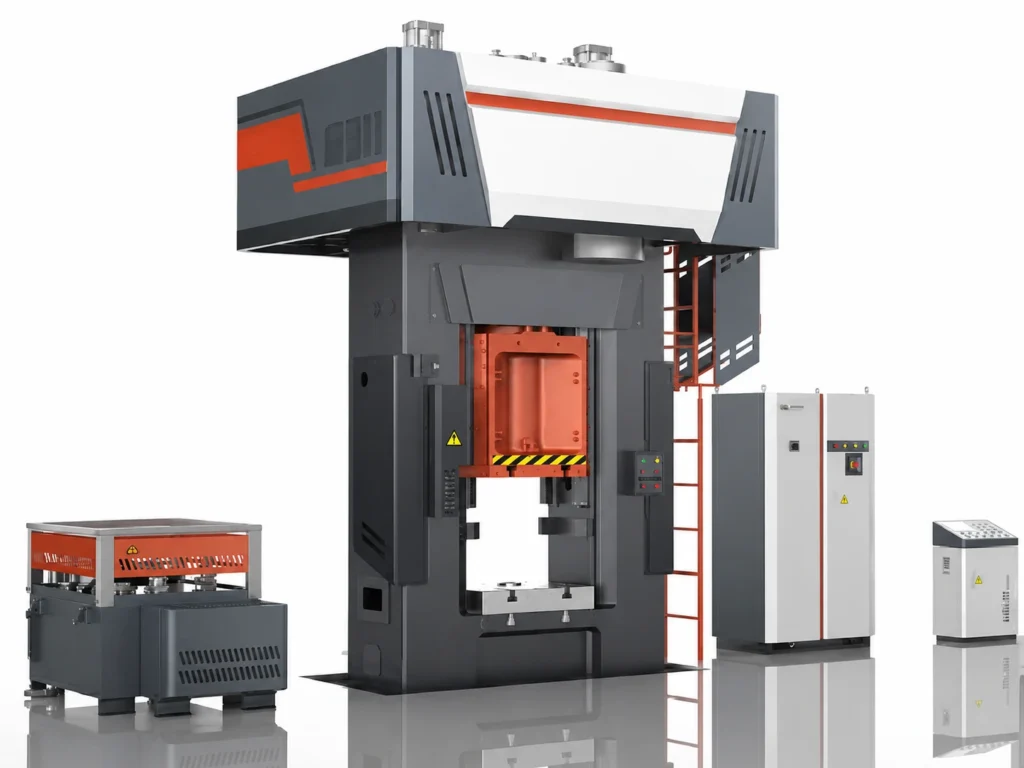
Electric Screw Press vs Friction Screw Press
Electric screw presses and friction screw presses both use a screw mechanism to generate slide movement, but they differ in how that movement is driven and controlled. The appropriate choice depends on the forged component, production requirements, existing factory equipment, maintenance strategy and investment priorities.
What Is an Electric Screw Press?
An electric screw press uses an electric motor and controlled drive arrangement to accelerate the machine’s rotating components. The screw mechanism converts this rotary motion into linear slide movement and transfers forming energy to the workpiece.
What Is a Friction Screw Press?
Friction Drive Arrangement
A traditional friction screw press uses friction discs or wheels to transmit motion to the flywheel and screw system. Contact between the friction components controls acceleration, working movement and return movement.
Drive-System Comparison
The principal difference is the drive and control arrangement. An electric screw press uses an electrically controlled drive, while a friction screw press relies on mechanical friction contact to transmit motion. This difference affects operation, adjustment, wear and maintenance.
Forming-Energy Control
An electric screw press can provide configurable energy and stroke settings for different components or forming stages. A friction screw press controls motion through its friction-drive arrangement, so the achievable adjustment and repeatability depend on the machine design, condition and control system.
Production Repeatability
An electric screw press can provide adjustable settings for different components or forming stages. A friction press can also be operated for different jobs, but its motion and energy control depend more heavily on the mechanical friction system and operator or control arrangement.
Maintenance Considerations
A friction screw press requires inspection and maintenance of friction discs, wheels and associated mechanical components. An electric screw press reduces dependence on friction transmission, although its motor, drive, bearings, lubrication system, screw mechanism and controls still require planned maintenance.
Energy and Operating Requirements
Actual energy use depends on machine size, operating settings, production cycle and line arrangement. Equipment selection should be based on the application and verified technical data rather than a general assumption that one drive type is always more efficient.
Automation and Line Integration
Both machine types may be incorporated into a wider production system, depending on their controls and configuration. Electric screw presses are commonly considered where coordinated settings and integration with billet heating, temperature monitoring, feeding, robot handling, lubrication and downstream equipment are priorities.
The required integration scope should be confirmed from the billet, cycle time, handling method, safety layout and downstream process.
When Might a Friction Press Be Considered?
A friction press may be considered where a factory already has suitable equipment, trained personnel, established tooling and a maintenance system for friction-driven machinery. The condition, remaining service life and capability of the proposed machine should be assessed.
When Might an Electric Screw Press Be Considered?
An electric screw press may be considered when configurable forming settings, repeatable production cycles and coordinated line integration are priorities. It may also suit factories that want to reduce dependence on friction transmission and use different operating settings for multiple components or forming stages.
How to Choose Between Them
Compare the two machines using the complete production requirement rather than the drive type alone. Review:
- Component drawings, material and billet dimensions
- Required forming energy and number of forging stages
- Production rate and repeatability requirements
- Existing dies, foundations, utilities and handling equipment
- Automation, control and data requirements
- Maintenance resources, spare parts and planned service life
- Total investment and long-term operating requirements
Frequently Asked Questions
Is an electric screw press always better than a friction press?
No. The suitable machine depends on the application, production target, existing factory conditions, maintenance resources and investment requirements.
Do friction screw presses require more adjustment?
Their friction components are wear items and normally require condition monitoring and adjustment. The exact maintenance requirement depends on the machine design and operating conditions.
Can both presses be used for closed die forging?
Both may be used for suitable closed die forging applications when their capacity, energy, tooling and production arrangements match the component.
Can a friction press be replaced with an electric screw press?
Potentially, but the dies, foundation, utilities, handling equipment, controls, clearances and process requirements must be reviewed before replacement.
What information is needed for a comparison?
Send the component drawing, material, billet dimensions, forging stages, production rate, existing machine details and factory layout.
Discuss Your Electric Screw Press Project
Send us your component drawing, material, billet dimensions, forging stages and required production rate for a technical review.
Electric Screw Press Solutions from Wiz Forging Machinery
Wiz Forging Machinery provides electric screw press and forging-line solutions for international manufacturers. Each enquiry is reviewed according to the component, material, process, output and factory requirements.