
Blog
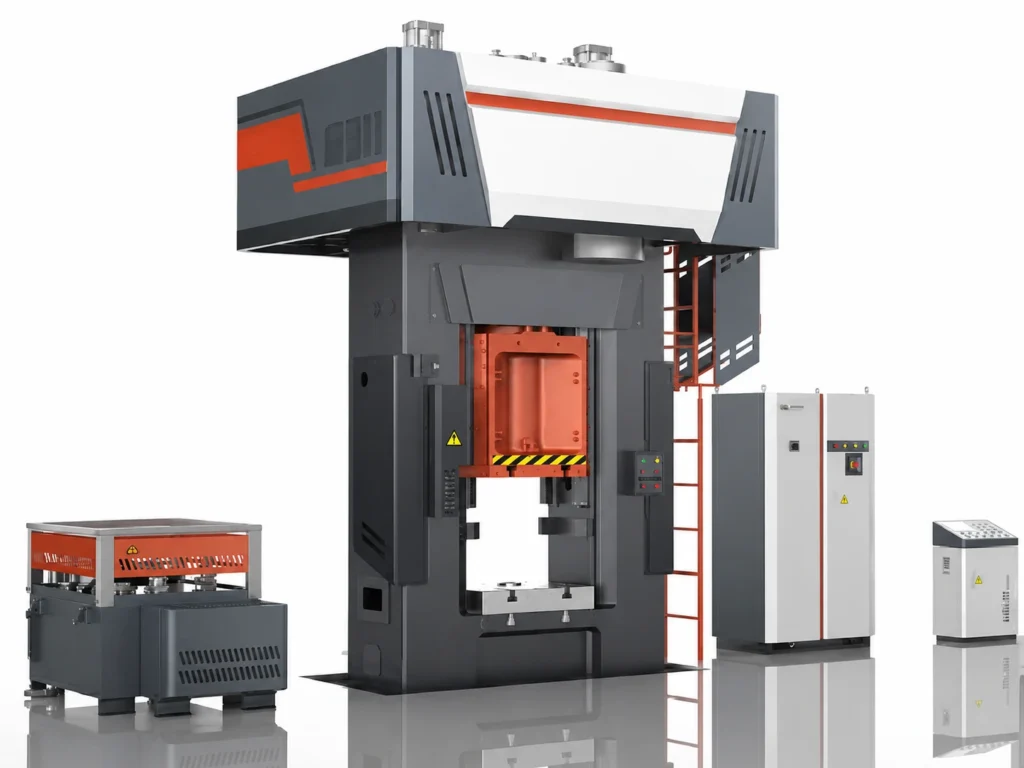
How Does an Electric Screw Press Work?
An electric screw press uses an electric drive and screw mechanism to move the slide and deliver forming energy to a workpiece. Its operating principle allows the energy used for each forging stage to be configured according to the component, material, billet, tooling and production requirements.
What Is an Electric Screw Press?
An electric screw press is an industrial forming machine in which an electric motor drives rotating components connected to a screw mechanism. This rotation produces the slide movement used to form material between the upper and lower dies.
How Is Motion Converted into Forming Energy?
The electric drive accelerates the machine’s rotating components. The screw mechanism converts this rotary motion into linear slide movement. As the slide approaches the workpiece, stored kinetic energy is transferred through the dies into the billet.
The Main Working Sequence
- A prepared billet is heated or otherwise conditioned for forming
- The billet is loaded into the die area
- The control system selects the required operating setting
- The drive accelerates the rotating components
- The screw mechanism moves the slide towards the workpiece
- The dies form the material during the working stroke
- The slide returns and the component is transferred to the next stage
Controlling the Forming Energy
Different components and forging stages may require different energy levels. The operating settings can be adjusted for pre-forming, blocking, finishing, sizing or calibration. The appropriate setting must be established through technical calculation and process trials.
What Happens During the Forging Stroke?
During the working stroke, the upper die moves towards the lower die and applies forming energy to the billet. The material flows within the die cavity according to its temperature, volume, geometry, friction conditions and the shape of the tooling.
Why Billet Temperature Matters
The billet must be within the specified temperature range when it reaches the press. Temperature affects material flow, required energy, die loading and the resulting component. Heating capacity, transfer time and temperature monitoring should therefore be coordinated with the press cycle.
How Dies Influence the Process
Die design determines how material is distributed and shaped. Cavity geometry, radii, draft, flash, lubrication and ejection all influence die filling and tool life. Complex components may require several impressions or forming stages.
Repeatability and Process Control
Repeatable press settings can support consistent production, but the complete process must also control billet dimensions, billet temperature, transfer time, lubrication, die condition and positioning. Press control cannot compensate for uncontrolled upstream variables.
Manual and Automated Loading
An electric screw press can operate with manual, mechanical or robotic loading. The correct method depends on billet weight, temperature, orientation, transfer distance, cycle time, production volume and factory safety requirements.
Supporting Equipment
- Billet cutting or preparation equipment
- Induction or other suitable heating equipment
- Temperature monitoring
- Feeders or handling robots
- Die lubrication equipment
- Trimming equipment
- Cooling and downstream conveyors
- Control and safety systems
Information Required for Machine Selection
- Finished component and forging drawings
- Material specification
- Finished, forged and billet weights
- Billet dimensions and temperature
- Projected forging area
- Number of forming stages or blows
- Die concept
- Required production rate
- Loading and automation requirements
- Factory layout and utilities
Electric Screw Press Solutions
Selecting an electric screw press requires a review of the component, material, billet, dies, forming stages, required output and automation level. Wiz Forging Machinery can assess these details and recommend a suitable press and supporting equipment.
Frequently Asked Questions
Does an electric screw press use hydraulic pressure?
No. Its primary forming motion is produced through an electric drive and screw mechanism rather than a hydraulic cylinder.
Can the forming energy be adjusted?
Yes. Operating settings can be configured for different components and forming stages within the machine’s suitable range.
Is an electric screw press suitable for closed die forging?
It may be suitable for closed die forging when the press capacity, energy range, dies, billet and production process are correctly matched.
Can it be integrated with automation?
Yes. Suitable applications can include automatic heating, temperature monitoring, feeding, robot transfer, lubrication, trimming and downstream handling.
What information is needed for a technical recommendation?
Provide the component drawing, material, billet details, forging temperature, forming stages, required output and factory requirements.
Discuss Your Electric Screw Press Project
Send us your component drawing, material, billet dimensions, forging stages and required production rate for a technical review.
Electric Screw Press Solutions from Wiz Forging Machinery
Wiz Forging Machinery provides electric screw press and forging-line solutions for international manufacturers. Each enquiry is reviewed according to the component, material, process, output and factory requirements.