
Blog
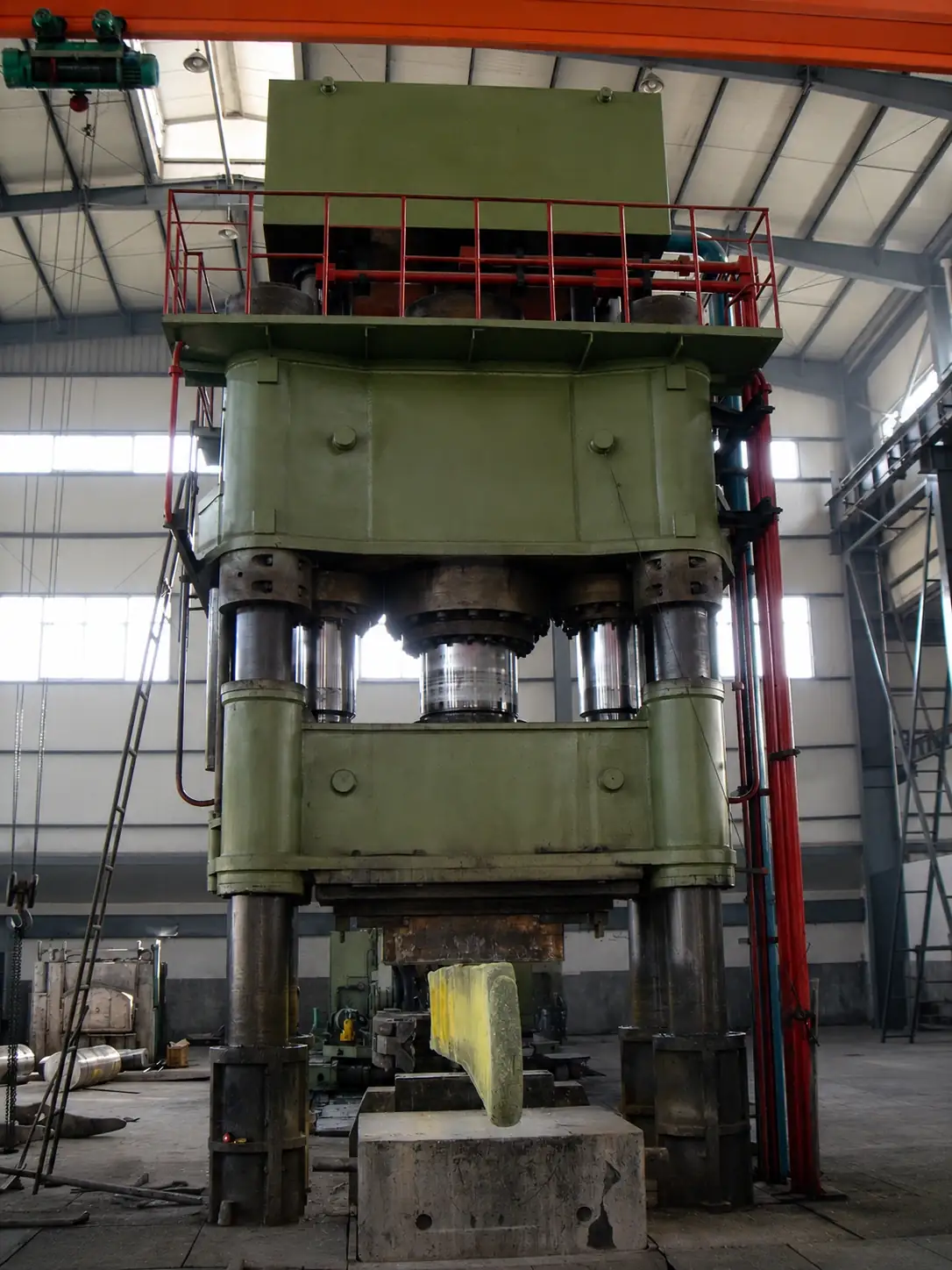
How Does a Hydraulic Open Die Forging Press Work?
Understanding how a hydraulic open die forging press works requires looking at the complete cycle: heating, transfer, positioning, controlled pressing, rotation and dimensional checking. The press supplies deformation force, while the tooling and handling system determine how that force is applied along the workpiece.
Available press specifications can be reviewed on the Hydraulic Open Die Forging Press machinery page.
How Hydraulic Force Produces Deformation
Electric motors drive hydraulic pumps that create oil flow and pressure. Control valves direct this fluid to the main cylinders, moving the slide towards the billet. When the tools contact the metal, hydraulic pressure rises and the system develops the force required for deformation.
The required pressure varies with contact area, material grade, billet temperature and reduction. The control system must manage both movement and force rather than treating every stroke identically.
Technical and Production Considerations
Approach, Working and Return Speeds
A typical cycle uses a rapid approach to reduce non-productive time, a controlled working speed during deformation and a rapid return after the stroke. Multi-stage speed control can combine productivity with stable forming force.
Role of the Upper and Lower Tools
Flat or shaped tools transmit force into the workpiece. Flat dies support general drawing, upsetting and flattening. V-dies, mandrels, punches, saddles and application-specific tools can be selected for particular sections and operations.
The Repeated Pressing Sequence
- Heat the billet or ingot to the specified forging temperature.
- Transfer and position it between the tools.
- Apply a controlled reduction.
- Release, rotate or advance the workpiece.
- Repeat according to the forging schedule.
- Check dimensions and reheat when required.
Drawing-Out and Upsetting
Drawing-out reduces cross-section and increases length through successive bites along the workpiece. Upsetting reduces length and increases cross-section. Both operations need a planned reduction sequence to manage metal flow, temperature loss and internal quality.
Punching, Piercing and Mandrel Forging
Punches and mandrels can create or enlarge central openings for rings, sleeves and hollow components. Tool alignment, support, lubrication and temperature control become particularly important because material must flow around the tooling without unacceptable defects.
Planning the Complete Forging Process
Workpiece Handling and Manipulator Control
Heavy billets are normally handled by a forging manipulator. Its clamp, lifting, travel and rotation movements must be coordinated with slide clearance. The operator or programme advances the workpiece by the required bite distance and controls rotation between strokes.
Force, Stroke and Position Control
Process repeatability improves when force limits, slide position and stroke endpoints are monitored. CNC functions can store sequences for repeat products, but programmes still require validation against actual material temperature, tooling and dimensional results.
Temperature and Process Stability
Metal flow resistance increases as the billet cools. Long transfer times or excessive reductions can therefore change loads and quality. Heating capacity, manipulator speed, bite sequence and reheating strategy must be planned together.
Safety and Interlocking
The system should incorporate emergency stops, guarded hydraulic and electrical areas, safe operating distances, overload protection and interlocks between the press and manipulator. Procedures are also required for tool changes, maintenance isolation and unexpected workpiece movement.
Frequently Asked Questions
What creates the force in a hydraulic forging press?
Hydraulic pumps and cylinders convert fluid pressure into controlled slide force.
Why does the workpiece move between strokes?
Repositioning and rotation distribute deformation along the billet and allow the required shape to be developed progressively.
What controls the amount of reduction?
Reduction is governed by slide position, stroke settings, force limits, tool geometry and the planned forging schedule.
Why is billet temperature important?
Temperature affects metal flow, required force, surface condition and the time available for each forging sequence.
Can the operation be CNC controlled?
Yes. CNC control can coordinate force, stroke and handling sequences, although process development and operator supervision remain essential.
What information is required for a technical quotation?
Please provide the finished-part and forging drawings, material grade, billet dimensions and weight, maximum workpiece dimensions, required forging operations, target output, heating method, handling method, factory voltage, available installation area and foundation information. These details allow the press, tooling, manipulator and auxiliary equipment to be reviewed as one production system.
Technical Review and Quotation
A stable forging cycle depends on the interaction between hydraulics, tooling, billet temperature, manipulator movement and dimensional control. Reviewing only the press force misses several factors that determine practical output and product quality.
Wiz Forging Machinery can review your application and recommend a suitable hydraulic open die forging press configuration. Send the available drawings and production information for a technical assessment.