
Blog
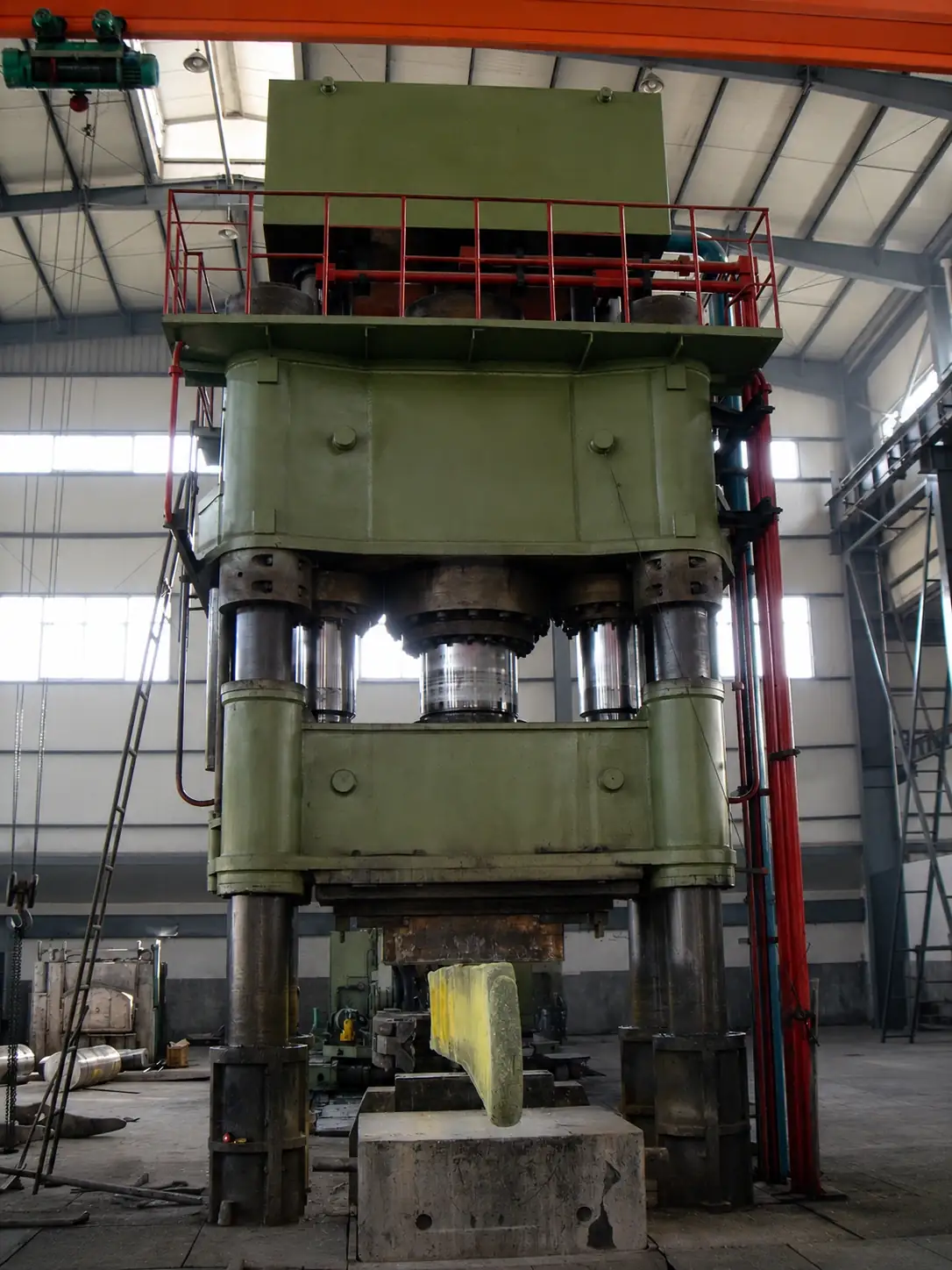
Hydraulic Free Forging Press: Process and Applications
A hydraulic free forging press is another common term for a hydraulic open die forging press. “Free forging” describes the progressive shaping of heated metal between tools that do not completely enclose the workpiece.
Reference models and specifications are available on the Hydraulic Open Die Forging Press machinery page.
Free Forging and Open Die Forging Terminology
Free forging and open die forging usually refer to the same broad process family. The billet remains accessible for rotation, feeding and repositioning. Tooling constrains selected surfaces while material is allowed to flow into the required form.
Technical and Production Considerations
How the Hydraulic Press Applies Force
Pumps and cylinders move the slide through rapid approach, controlled deformation and return. Force and position can be monitored throughout the stroke. This supports gradual working of large sections.
Core Free Forging Operations
- Drawing and elongation
- Upsetting and heading
- Flattening and sizing
- Punching and piercing
- Mandrel forging
- Bending and offsetting
- Preforming for downstream operations
Typical Industrial Applications
Applications include power-generation shafts, marine components, rolls, pressure-vessel parts, rings, discs, tooling blocks, mining-equipment parts and general heavy machinery forgings.
Tools Used for Free Forging
Flat dies provide general flexibility. V-dies improve support for round sections. Fullers, punches, mandrels, saddles and special tools perform local operations. Tool dimensions and fixing must match the press and workpiece.
Material Behaviour and Temperature
Each alloy has an appropriate forging-temperature range and deformation behaviour. Temperature loss raises flow stress and may reduce formability. Heating, transfer, reduction schedule and reheating should therefore be planned together.
Planning the Complete Forging Process
Selecting the Required Press Force
Required force is assessed from contact area, material strength at temperature, reduction and tool geometry. Selecting solely from billet or finished weight can result in insufficient force or unnecessary investment.
Workpiece Handling
Manual tongs may suit small work, but heavy billets require a manipulator or charging machine. Handling equipment should match maximum weight, dimensions, required rotation and travel.
Production Flexibility
One free-forging press can produce varied components, but every product must remain within the machine’s force and geometric envelope. Flexible production also requires suitable tool storage, change procedures and process documentation.
Ownership and Service Planning
Operating plans should include hydraulic-fluid cleanliness, seal and hose inspection, guide maintenance, calibration, spare parts and operator training. Planned servicing reduces the risk of extended stoppages.
Frequently Asked Questions
Is free forging the same as open die forging?
The terms are commonly used for the same progressive forging process in which the workpiece is not fully enclosed by shaped dies.
What products can a free forging press make?
Typical products include shafts, rings, discs, blocks, bars, rolls and large industrial components.
What materials can be free forged?
Carbon, alloy, stainless and tool steels are common, subject to their specific temperature and process requirements.
Does free forging require special dies?
It uses flat or shaped tools such as V-dies, fullers, punches and mandrels according to the operation.
How is machine capacity selected?
Capacity is calculated from material, temperature, contact area, reduction schedule, tooling and workpiece dimensions.
What information should be provided for a quotation?
Provide the finished-part and forging drawings, material specification, billet dimensions and weight, maximum hot-workpiece dimensions, required operations, production target, heating method, handling requirements, factory voltage, available space and foundation information.
Technical Review and Quotation
The terminology may vary, but the engineering requirement remains the same: press force, clearances, tooling and handling must be matched to the actual forging route.
Wiz Forging Machinery can review the application and recommend a suitable press and supporting equipment.