
Blog
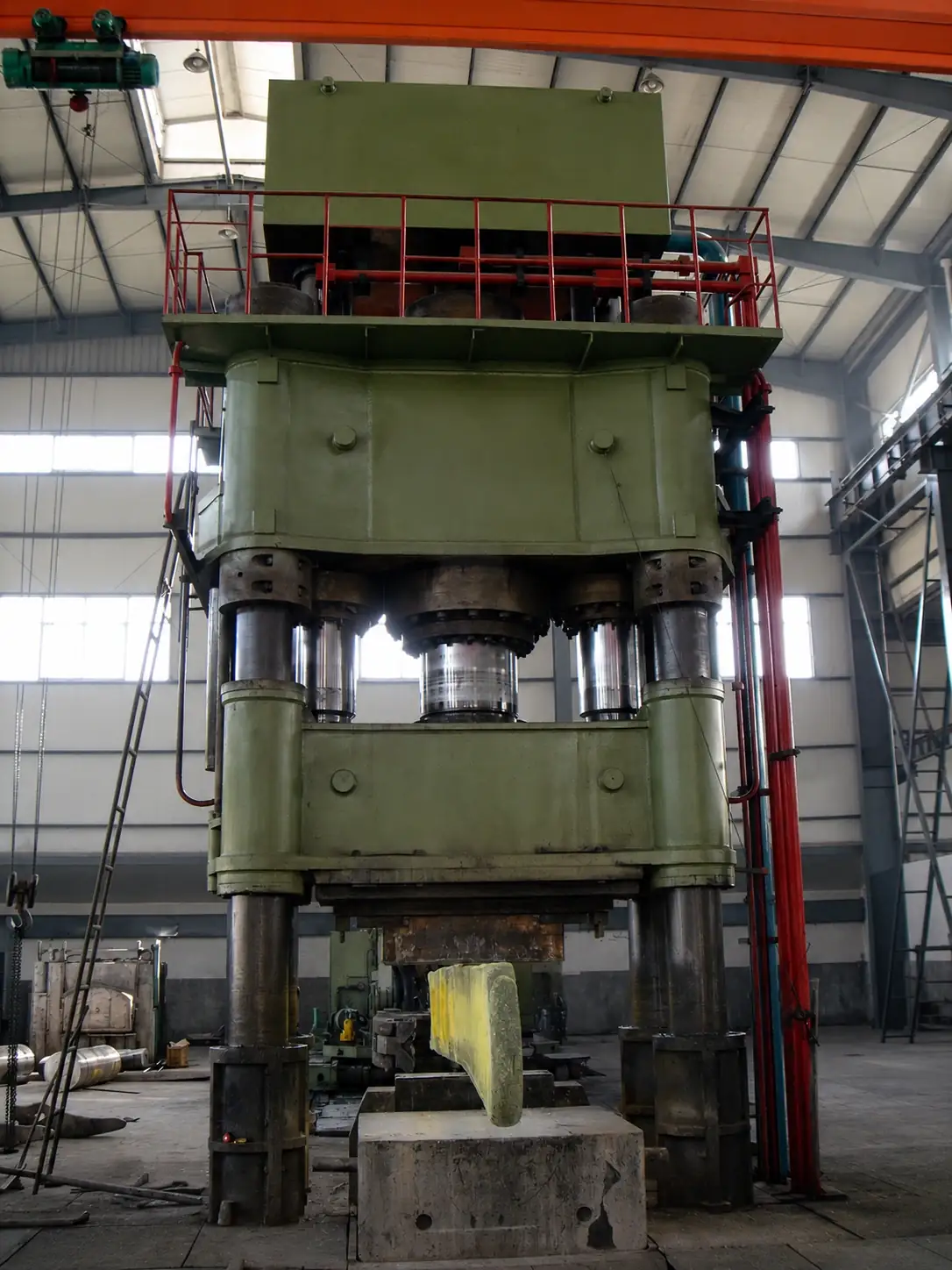
Hydraulic Open Die Forging Press: Complete Machine Guide
A hydraulic open die forging press applies controlled compressive force to heated metal while the workpiece remains partly exposed between relatively simple tools. The billet is repeatedly pressed, rotated and repositioned until it reaches the required section and dimensions.
This guide explains how the equipment works, where it is used and what must be assessed before selecting a press. For available configurations, visit the Hydraulic Open Die Forging Press machinery page.
What Is a Hydraulic Open Die Forging Press?
The press uses hydraulic cylinders to move the working slide and transmit force through the upper tool into the heated billet. Unlike impression-die equipment, the tools do not completely enclose the workpiece. This gives the operator or manipulator freedom to draw, upset, flatten, pierce and shape large components progressively.
Open die pressing is particularly valuable when components are too large for conventional closed dies, when production quantities are moderate, or when several product sizes must be made on one machine.
Technical and Production Considerations
Working Principle
Hydraulic pumps deliver pressurised fluid to the main cylinders. The slide approaches rapidly, changes to a controlled working speed during deformation and returns after the required reduction. The workpiece is then rotated or advanced before the next stroke.
Modern configurations coordinate slide movement, working force, stroke position and manipulator motion. The forging sequence remains dependent on billet temperature, reduction schedule, material behaviour and operator or CNC programme settings.
Common Forging Operations
- Upsetting to increase cross-section and reduce length
- Drawing-out to reduce section and extend the workpiece
- Flattening and sizing
- Punching, piercing and mandrel operations
- Bending and offset forging
- Preforming for ring rolling or machining
Typical Forged Products
Typical products include shafts, axles, rings, discs, cylinders, bars, blocks, flanges, rolls and heavy machinery components. The same press may handle different product families when its force, daylight, stroke, worktable and handling system are suitable.
Materials That Can Be Processed
Applications can include carbon steel, alloy steel, stainless steel, tool steel and other forgeable metals. Each grade has a different temperature window, flow stress and reduction requirement. The exact material specification is therefore essential for equipment and process selection.
Reference WM-HODP Range
Wiz Forging Machinery offers reference configurations from WM-HODP-800 to WM-HODP-2500, corresponding to nominal pressures from 8 MN to 25 MN. Reference slide strokes range from 1,000 to 1,600 mm, with model-dependent clearance, table travel, working speed and installed power.
These figures are starting points rather than automatic selections. Final specifications must be confirmed from the component, billet and forging schedule.
Planning the Complete Forging Process
How Press Capacity Is Selected
Nominal force alone is not enough. Selection must consider projected contact area, material resistance at forging temperature, required reduction per stroke, billet dimensions, final section, tool geometry and process sequence. Adequate daylight and stroke are also needed for safe handling and tooling.
Production-Line Integration
A complete installation may combine billet preparation, furnace or induction heating, temperature measurement, a hydraulic press, forging manipulator, travelling worktable, dies, cooling and inspection. Controls should coordinate material transfer without unnecessarily extending the hot-metal cycle.
Installation and Ownership Considerations
Buyers should assess foundation loads, building height, lifting access, electrical capacity, hydraulic-room arrangement, cooling requirements, oil management and maintenance clearances. Installation planning should begin before the equipment is dispatched.
When This Press Is a Suitable Choice
A hydraulic open die press is suitable when the process needs high controlled force, gradual deformation, flexible workpiece positioning and the ability to forge large or varied components. A technical review should compare it with forging hammers, ring rolling machines and other forming equipment according to the actual product route.
Frequently Asked Questions
What is a hydraulic open die forging press used for?
It is used to forge large or varied components such as shafts, rings, discs, bars and heavy industrial parts through repeated controlled pressing and repositioning.
How is open die forging different from closed die forging?
Open die forging leaves the workpiece partly exposed between simple tools, while closed die forging forms material inside shaped die cavities.
What press capacities are available?
Reference WM-HODP configurations cover 8 MN to 25 MN, although larger or customised specifications can be reviewed for the application.
Does the press require a forging manipulator?
A manipulator is strongly recommended for heavy, long or high-output workpieces because it supports lifting, rotation, feeding and repeatable positioning.
Can the press be automated?
Yes. Slide control, force control, stroke position, manipulator movement and supporting line equipment can be coordinated to the required automation level.
What information is required for a technical quotation?
Please provide the finished-part and forging drawings, material grade, billet dimensions and weight, maximum workpiece dimensions, required forging operations, target output, heating method, handling method, factory voltage, available installation area and foundation information. These details allow the press, tooling, manipulator and auxiliary equipment to be reviewed as one production system.
Technical Review and Quotation
The final recommendation should be based on engineering calculations and the complete production route. Component weight by itself is not a reliable basis for selecting force, stroke, daylight or handling equipment.
Wiz Forging Machinery can review your application and recommend a suitable WM-HODP hydraulic open die forging press configuration. Send the available drawings and production information for a technical assessment.