
Blog
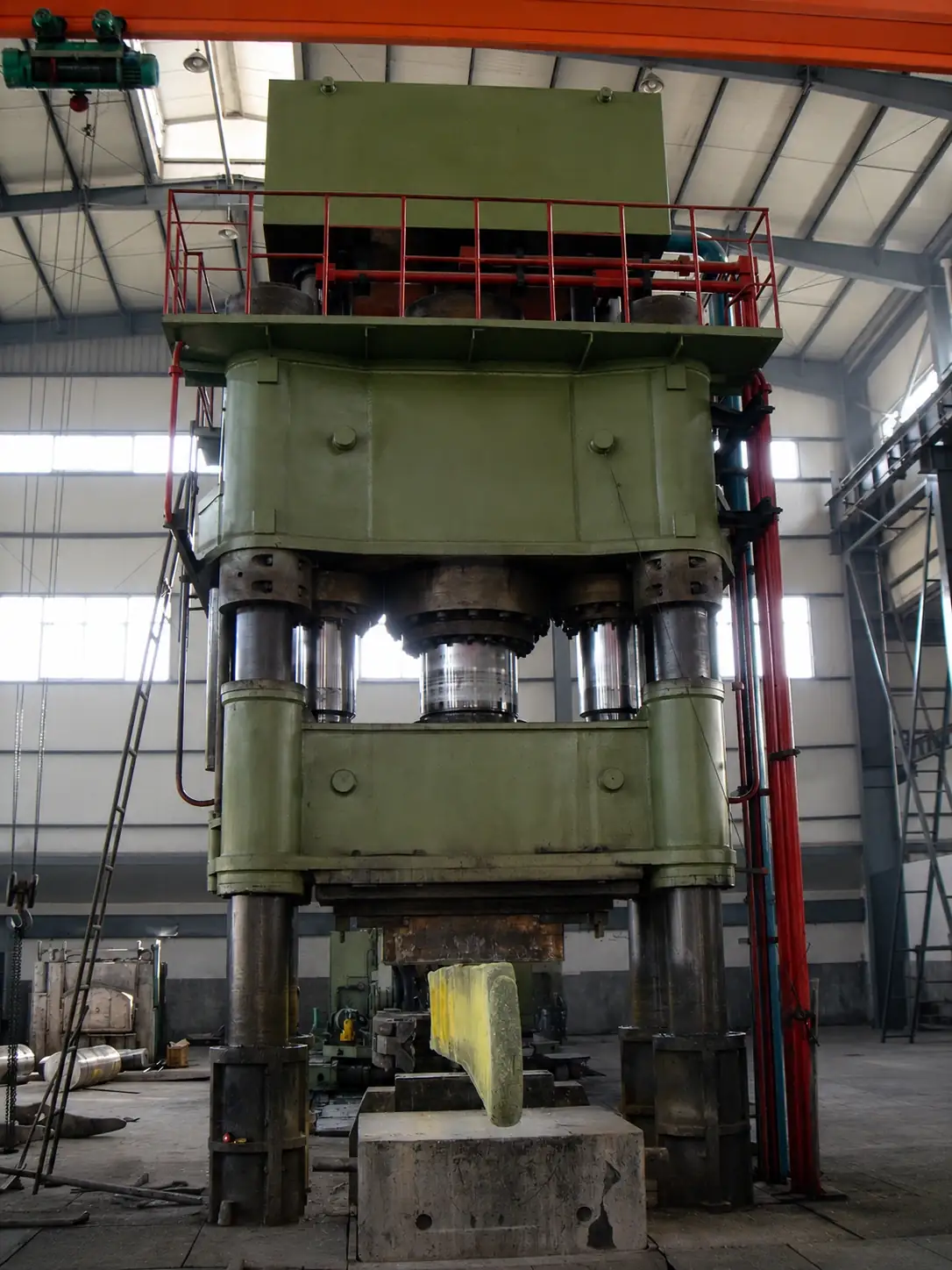
Open Die Forging Press for Heavy Parts and Large Forgings
An open die forging press for heavy parts must combine adequate force with sufficient daylight, stroke, worktable travel and handling capacity. Large forgings cannot be assessed by finished weight alone because shape, material, starting billet and reduction schedule all influence the required machine.
See the available Hydraulic Open Die Forging Press configurations for reference specifications.
Why Heavy Forgings Use Open Die Pressing
Open die pressing allows a large billet or ingot to be worked progressively rather than enclosed inside one complete impression. This makes the process adaptable to long shafts, thick discs, rings, cylinders and one-off or moderate-volume components.
Controlled pressing can support deep deformation and measured reductions, provided the workpiece remains within the press and manipulator operating envelope.
Technical and Production Considerations
Heavy Shaft and Axle Forging
Shaft production commonly uses upsetting, drawing-out, shoulder formation and local sizing. Long components require coordinated manipulator travel and rotation so that reductions remain even along the axis. Straightness and dimensional checks should be built into the sequence.
Rings, Discs and Flange Preforms
The press can upset billets into discs, pierce central holes and prepare ring blanks for mandrel forging or ring rolling. The correct preform reduces downstream rolling work and supports stable material distribution.
Large Blocks, Bars and Cylinders
Rectangular blocks and bars may be forged by repeated passes with rotation between orientations. Cylindrical products may use flat or shaped dies depending on the required section and surface. Sufficient clearance is needed for tools, workpiece and manipulator jaws.
Material and Ingot Considerations
Large ingots can contain segregation, porosity and non-uniform temperature. The forging schedule should be developed to achieve the required internal working while controlling surface cracking and excessive temperature loss. Material grade and ingot history must be supplied during technical review.
Force and Contact Area
The necessary force increases with projected die contact area and material flow stress. A long bite or broad tool face can require substantially more force than a smaller local reduction. Calculations should therefore use the actual stages rather than only final component dimensions.
Planning the Complete Forging Process
Daylight, Stroke and Table Travel
Daylight determines whether the billet, tools and handling equipment can enter the press safely. Stroke must cover approach, deformation and clearance. A travelling worktable can improve tool access and support efficient handling of heavy components.
Manipulator Capacity and Reach
The manipulator must be sized for the hottest and heaviest workpiece, including tongs or clamps. Capacity, lifting stroke, travel, rotation torque and jaw design should match the complete size range. Under-sizing the handling equipment can restrict an otherwise suitable press.
Heating and Reheating Strategy
Furnace capacity must match billet dimensions and production demand. Heavy parts may require reheating between stages. Layout should minimise transfer distance and allow safe return to the furnace without obstructing the press operating area.
Quality and Dimensional Control
Production planning may include temperature monitoring, dimensional measurement, straightness checking, ultrasonic inspection and mechanical testing. Acceptance criteria should be defined before finalising the equipment and process route.
Frequently Asked Questions
What heavy components can an open die press produce?
Typical products include large shafts, axles, rings, discs, cylinders, blocks, bars, rolls and flange preforms.
Is finished component weight enough to select the press?
No. Material, billet size, contact area, reduction schedule, tooling, daylight and manipulator requirements must also be assessed.
Why is a manipulator important for large forgings?
It supports lifting, feeding and rotation while maintaining controlled positioning between press strokes.
Can one press make different heavy products?
Yes, when force, clearances, tooling and handling range cover the different components and processes.
Do large forgings require reheating?
Often they do, depending on workpiece mass, material, operation time, transfer distance and permitted temperature range.
What information is required for a technical quotation?
Please provide the finished-part and forging drawings, material grade, billet dimensions and weight, maximum workpiece dimensions, required forging operations, target output, heating method, handling method, factory voltage, available installation area and foundation information. These details allow the press, tooling, manipulator and auxiliary equipment to be reviewed as one production system.
Technical Review and Quotation
For heavy forgings, press selection and process planning are inseparable. The press, manipulator, furnace, tools, building and inspection route should be reviewed as one project before a final quotation is issued.
Wiz Forging Machinery can review your application and recommend a suitable hydraulic open die forging press configuration. Send the available drawings and production information for a technical assessment.