
Blog
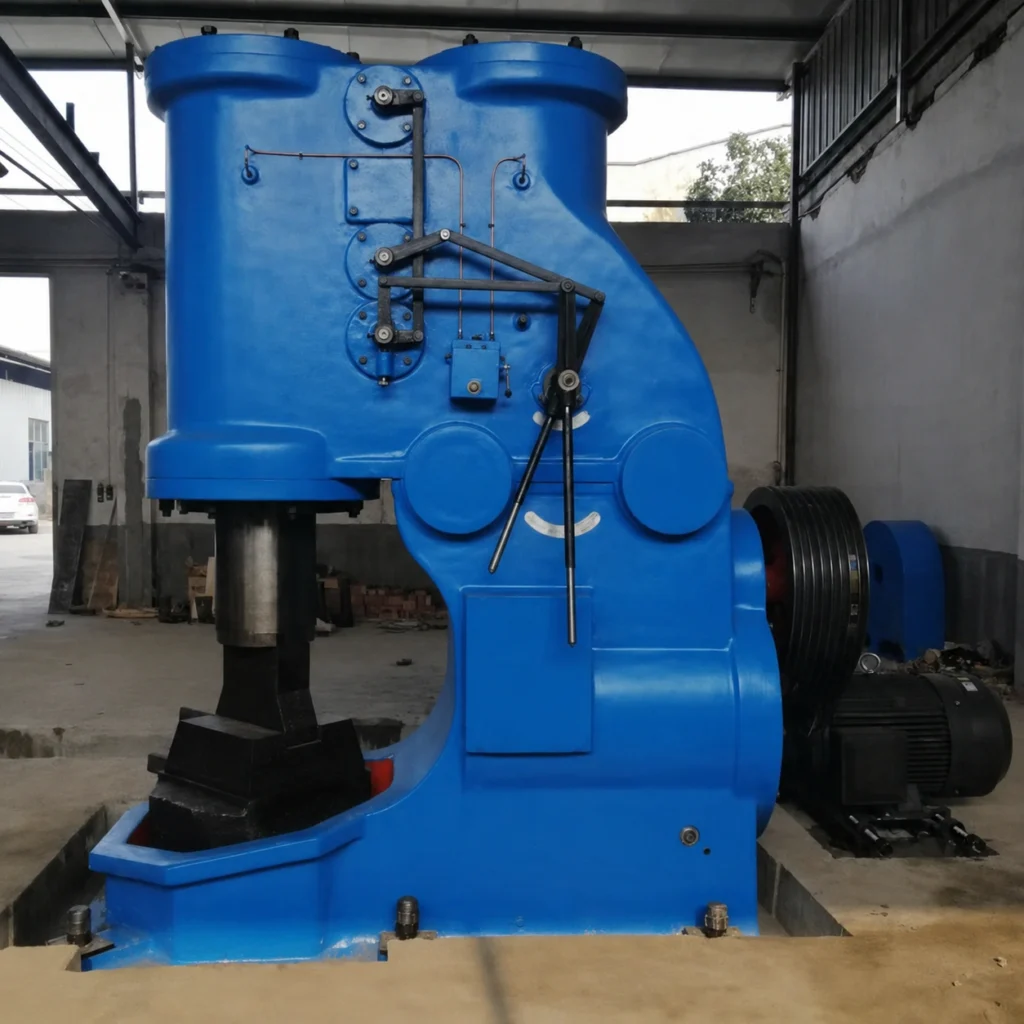
What Is a Pneumatic Forging Hammer? Open Die Forging Guide
A pneumatic forging hammer is a self-contained impact forging machine used to shape heated metal through controlled, repeated blows. It is widely applied in open die forging, toolmaking, repair workshops and industrial production where operators need flexible control over drawing, upsetting, bending, punching and finishing operations.
This guide explains the operating principle, suitable applications, production-line integration and selection information buyers should prepare. For machine capacities and configuration support, view our pneumatic forging hammer machinery.
What Is a Pneumatic Forging Hammer?
A pneumatic forging hammer, also called an air hammer or pneumatic power hammer, normally combines a motor, crank mechanism, compressor cylinder, working cylinder, ram, upper die, lower die and anvil structure in one machine. The machine produces compressed air internally, so a separate external air compressor is not normally required for the hammering action.
The operating mechanism raises and drives the ram while the operator controls the frequency and strength of the blows. Heated metal is positioned between the dies and progressively formed rather than being shaped in one continuous pressing stroke. This makes the machine particularly useful for open die forging and work that requires repeated repositioning of the workpiece.
What Are the Main Capabilities of a Pneumatic Forging Hammer?
1. Controlled Repeated Impact
The operator can use lighter blows for positioning and finishing, then stronger blows when more deformation is required. Actual control range depends on the hammer design, tooling, workpiece and operating method.
This flexibility helps the operator develop the shape in stages and respond to changing workpiece dimensions during open die forging.
2. Drawing-Out and Length Reduction
Drawing-out reduces the cross-section and increases the length of a heated billet. The workpiece is rotated and advanced between repeated blows so deformation is distributed along the required area.
Stable handling and correct reheating are important because temperature loss can change material flow and increase the effort needed to continue forging.
3. Upsetting and Section Enlargement
Upsetting shortens the workpiece and increases its cross-section. It can be used to prepare stock for flanges, heads, discs and other enlarged sections.
The billet dimensions, heating uniformity, die faces and required upset ratio should be assessed before the hammer capacity is selected.
4. Bending, Punching and Hot Cutting
With suitable dies and tools, a pneumatic forging hammer can support bending, punching, chiselling and hot-cutting operations. These operations require application-specific tooling and safe workpiece handling.
Tool clearances, die fixing, workpiece temperature and operator access must be confirmed during process planning.
5. Flexible Workpiece Repositioning
Open die forging often requires the billet to be rotated, turned or fed between blows. Small workpieces may be handled with tongs, while larger billets may require a manipulator or other handling equipment.
The chosen handling method should match the workpiece weight, length, temperature and production target.
6. Production from Workshop to Industrial Scale
How Does Open Die Forging Work with a Pneumatic Hammer?
Pneumatic forging hammers are available across a broad capacity range. Smaller machines may suit blacksmithing, maintenance and toolmaking, while heavier configurations support industrial open die forging.
Selection should be based on the actual forged part and process rather than choosing a hammer only by nominal ram or falling-part weight.
In open die forging, the heated workpiece is not fully enclosed in a shaped die cavity. It is formed between flat, curved or application-specific dies while being repositioned between blows.
| Process Stage | Typical Requirement | Planning Consideration |
|---|---|---|
| Billet preparation | Correct stock size and weight | Cutting accuracy and material grade |
| Heating | Suitable and uniform forging temperature | Furnace capacity and transfer time |
| Initial forming | Controlled deformation | Die face and blow intensity |
| Repositioning | Rotation or feeding between blows | Tongs, operator access or manipulator |
| Finishing | Dimensional and surface control | Final passes and inspection allowance |
The exact sequence depends on the material, starting billet, final geometry and quality requirements.
Which Applications Are Suitable?
A pneumatic forging hammer may be considered for shafts, bars, rings, discs, agricultural tools, hand tools, hardware, repair components and preforms. It can also support operations such as drawing, upsetting, flattening, bending and punching.
Suitability cannot be confirmed from the product name alone. Buyers should provide drawings or photographs, material specifications, billet dimensions, finished dimensions, workpiece weights and required output so the forging route can be reviewed.
How Should the Hammer Be Integrated into a Production Line?
A complete arrangement may include billet cutting, furnace or induction heating, temperature checking, transfer equipment, the forging hammer, dies, workpiece handling, cooling and inspection. Larger billets may require a rail-bound or mobile manipulator.
Factory planning should allow space for the hammer foundation, heating equipment, material flow, die changes, maintenance access and safe operating zones. Electrical supply, foundation conditions and local safety requirements must be confirmed before installation.
What Information Is Needed to Select a Pneumatic Forging Hammer?
For a technical recommendation and quotation, provide:
- Finished-part drawing, photograph or sample dimensions
- Material grade and required forging temperature
- Starting billet diameter, length and weight
- Maximum forged dimensions and workpiece weight
- Required forging operations and number of heats
- Target pieces per hour, shift or year
- Existing furnace, dies and handling equipment
- Factory voltage, frequency and available power
- Installation area, floor condition and foundation information
- Required automation, manipulator and safety scope
This information allows the hammer, tooling and supporting equipment to be considered as one process.
Frequently Asked Questions
Does a pneumatic forging hammer need an external air compressor?
A self-contained pneumatic forging hammer normally produces its working air internally through its compressor and working cylinders. Auxiliary equipment may still require separate services depending on the final configuration.
What operations can the hammer perform?
Common operations include drawing-out, upsetting, flattening, bending, punching, chiselling and hot cutting when suitable dies and tools are used.
Is it suitable for open die forging?
Yes. Pneumatic forging hammers are widely used for open die and free forging because the workpiece can be repositioned between repeated blows.
How is the correct hammer capacity selected?
Selection considers billet and forged-part dimensions, material, workpiece weight, deformation required, tooling, handling method and production rate. Nominal hammer size alone is not enough.
Can a manipulator be added?
Yes. Larger or heavier workpieces may be handled by a suitable forging manipulator. Its gripping range, capacity, travel and coordination with the hammer must be assessed.
What should a buyer send for a quotation?
Send component drawings, material grade, billet data, finished dimensions, maximum weight, process description, output target, factory power supply and layout information.
Technical Review and Pneumatic Forging Hammer Quotation
Wiz Forging Machinery reviews the workpiece, material, billet, forging sequence, handling method and production target before recommending a suitable pneumatic forging hammer and supporting equipment.
For a technical review, send your drawings, material specification, billet dimensions, maximum forging weight and required output. Request a quotation or review the available pneumatic forging hammer configurations.