
Blog
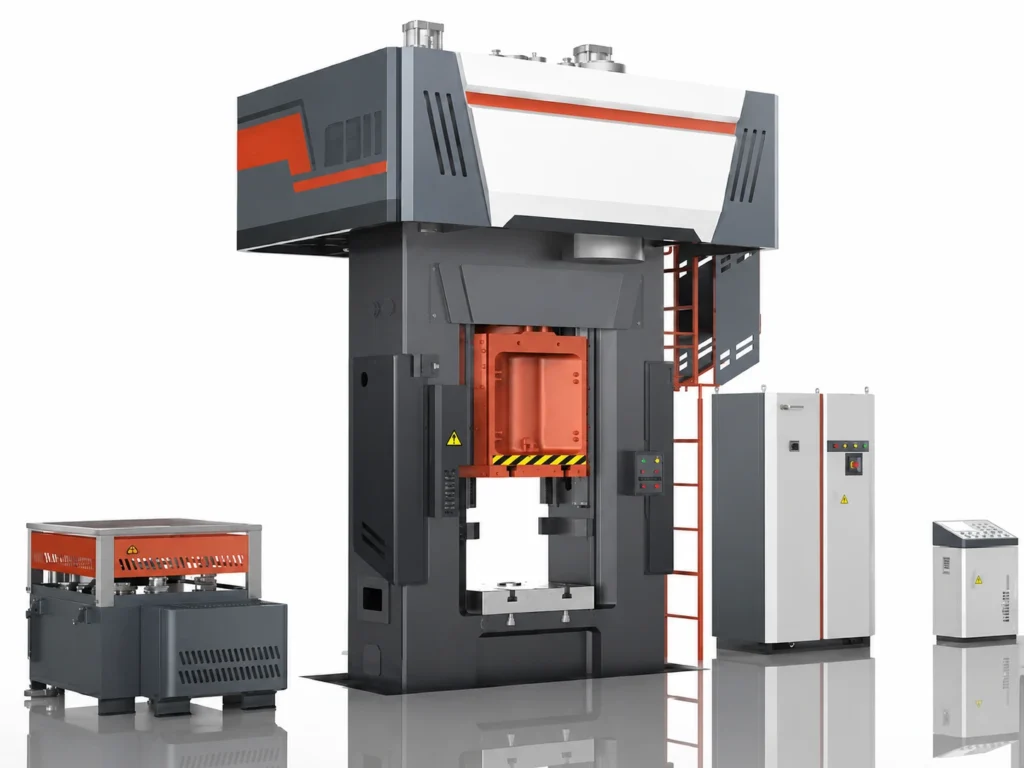
Why Choose an Electric Screw Press for Forging?
An electric screw press is selected for forging when a manufacturer needs controllable forming energy, repeatable production and flexibility across different forged components. It is particularly suitable for hot forging, closed die forging, precision forming, sizing, coining and calibration processes.
Unlike a press with a fixed mechanical stroke, a screw press delivers energy through the movement of its screw-driven slide. The forming energy can be adjusted according to the workpiece, material, die and required forging stage. This makes the machine suitable for both standalone production and automated forging lines.
What Is an Electric Screw Press?
An electric screw press is an industrial forging machine that uses an electric drive and screw mechanism to move the slide and apply forming energy to a workpiece.
During the forging cycle, the drive system accelerates the moving components and transfers energy through the screw mechanism. The upper die moves towards the workpiece, and the stored energy is absorbed as the material is formed.
Depending on the machine design, the drive arrangement may incorporate a motor, flywheel, gears or a direct-drive system. The correct configuration should be selected according to the required forging energy, production rate, component dimensions and automation level.
Electric screw presses are commonly considered for:
- Hot closed die forging
- Precision forging
- Pre-forging and final forging
- Sizing and calibration
- Coining
- Aluminium and copper-alloy forming
- Automated forged-component production
The suitability of a particular machine must always be confirmed against the component drawing, material, billet dimensions, die arrangement and production target.
What Are the Main Advantages of an Electric Screw Press?
1. Controllable Forging Energy
One of the principal advantages of an electric screw press is the ability to control the energy delivered during the forging stroke.
Different components and forming stages may require different energy settings. A pre-forging operation, for example, may not require the same energy as final forging or calibration. Controllable energy allows the production process to be configured around the actual forming requirement.
Appropriate energy control can help:
- Improve consistency between forging cycles
- Avoid applying unnecessary energy
- Support stable die filling
- Reduce excessive loading on the tooling
- Adapt the machine to different components and materials
The selected energy still needs to be validated through forging trials and process engineering. Die design, billet temperature, lubrication and material behaviour also influence the final result.
2. Repeatable Forging Quality
Repeatability is important when producing forged components in batches. Variations in energy, billet temperature, transfer time or die positioning can affect dimensions, die filling and surface quality.
An electric screw press can form part of a controlled production process in which the forging parameters are set for a particular component. This supports consistent operation and is especially relevant to automotive forgings, machinery components, hardware and tools, agricultural machinery parts, railway components, aluminium alloy forgings, and brass or copper-alloy parts.
The press alone does not determine component quality. Stable heating, correct billet preparation, suitable tooling and consistent material handling remain essential.
3. Suitable for Closed Die Forging
An electric screw press is frequently used for closed die forging, where heated material is formed between shaped upper and lower dies. The screw press combines a press-type forming action with energy-controlled operation, making it suitable for components that require controlled material flow and repeatable die filling.
Potential applications include connecting rods, gear blanks, flanges, levers, control arms, hand tools, couplings, fasteners, brass fittings and aluminium components. These are possible applications rather than universal capabilities. The required press size and configuration depend on projected area, component geometry, material, billet weight and forging process.
4. Flexible Energy for Different Forging Stages
A forged component may require several stages before reaching its final form. These can include billet preparation, pre-forming, blocking, final forging, trimming and calibration.
The ability to configure forging energy for different stages gives an electric screw press useful process flexibility. A machine may be incorporated into a single-stage operation or a multi-stage production arrangement. This is valuable for manufacturers producing several component types or planning future production changes, although the selected machine must provide a suitable operating margin for every intended product.
5. Integration with Forging Automation
Electric screw presses can be integrated with supporting equipment to create a complete or partially automated forging line. A production line may include:
- Billet cutting equipment
- An induction heating system
- Temperature monitoring
- Billet feeding or robotic transfer
- The electric screw press
- Die lubrication equipment
- A trimming press
- Cooling or controlled material handling
- Production monitoring and safety systems
The exact arrangement depends on the forging sequence, target output, available floor space and automation level. Automated handling can reduce manual contact with hot components and help maintain a more consistent transfer time between heating and forging.
Learn more about complete electric screw press forging lines.
6. Reduced Dependence on Friction Transmission
Electric Screw Press, Friction Press or Power Hammer?
Traditional friction screw presses use friction discs or wheels to transmit motion. These systems can require regular adjustment and monitoring as their friction components wear.
An electric screw press uses a controlled electrical drive arrangement. Depending on its design, it may reduce dependence on the conventional friction transmission system and provide more consistent control over the forging cycle. Actual maintenance requirements depend on the drive configuration, operating conditions, lubrication, production intensity and preventive maintenance programme.
For a detailed comparison, read Electric Screw Press vs Friction Press.
The most suitable forging machine depends on the required process rather than one machine being universally better.
| Consideration | Electric Screw Press | Friction Screw Press | Power Hammer |
|---|---|---|---|
| Typical forming method | Controlled energy through a screw-driven slide | Screw-driven movement using friction transmission | Repeated hammer blows |
| Common application | Closed die and precision forging | General forging and forming | Open die and flexible hammer forging |
| Energy adjustment | Electrically controlled, subject to machine design | More dependent on friction transmission and adjustment | Blow energy controlled through the hammer system |
| Automation potential | Well suited to integrated production lines | Possible, depending on machine and controls | Available for suitable die-forging applications |
This is a general comparison because individual machine designs vary. Manufacturers should assess the forged component, forming stages, production volume, tolerances, tooling and factory infrastructure. Read the full comparison between an electric screw press and a power hammer.
When Is an Electric Screw Press a Suitable Choice?
An electric screw press may be suitable when:
- The process requires controllable forging energy
- Components are produced through closed dies
- Repeatability is important across production batches
- Several energy settings are needed during forming
- The factory plans to introduce automated handling
- The work involves hot or precision forging
- The manufacturer wants to replace an older friction press
- Production data and process settings need to be managed more consistently
It may not be the correct choice for every application. Large open die forgings, highly flexible manual shaping work or processes requiring a different force-displacement characteristic may be better suited to other forging equipment. A technical review should be completed before selection.
How Do You Select the Correct Electric Screw Press?
Press selection should not be based on nominal capacity alone. The manufacturer or machinery supplier should review the complete forging process, including:
- Finished component drawing and material
- Finished and trimmed weight
- Billet dimensions and weight
- Forging temperature
- Projected forging area
- Number of forming stages
- Die drawing or proposed die arrangement
- Required production rate
- Existing heating equipment
- Manual or automated loading requirement
- Available power supply
- Factory dimensions and foundation conditions
The machine can then be assessed according to available forging energy, load capacity, slide movement, working area, production rate and compatibility with the dies and supporting equipment. Read our detailed guide on how to choose an electric screw press.
Can an Electric Screw Press Form Different Materials?
Electric screw presses can be configured for different metals, including steel, aluminium alloys, brass and other copper alloys. These materials do not behave identically during forging and can require different temperatures, strain rates, die designs, lubrication methods and energy settings.
The material must therefore be confirmed during machine selection. A general statement that a press can forge a material is not enough to establish suitability for a specific component. Forging trials or process calculations may be required for technically demanding applications.
Frequently Asked Questions
What is an electric screw press used for?
An electric screw press is used for metal-forming operations such as hot forging, closed die forging, precision forging, sizing, coining and calibration. Suitability depends on the component, material, die and required forming energy.
How does an electric screw press work?
An electric drive accelerates the machine’s moving components and transfers energy through a screw mechanism. The slide moves towards the workpiece, and the available energy is absorbed as the material is formed inside or between the dies.
Is an electric screw press suitable for closed die forging?
Yes. Electric screw presses are commonly considered for closed die forging because they provide adjustable forming energy and repeatable operation. The machine still needs to be selected according to component geometry, projected area, billet and die arrangement.
What is the difference between an electric screw press and a friction press?
The main difference is the drive and control arrangement. A traditional friction press transfers movement through friction components, while an electric screw press uses an electrically controlled drive system. This can provide improved control and easier integration with modern automation.
Can an electric screw press be automated?
Yes. Depending on the application, it can be integrated with billet cutting, induction heating, temperature detection, robotic transfer, die lubrication, trimming and other production-line equipment.
How is the correct press capacity calculated?
Selection requires more than the finished component weight. The component drawing, projected forging area, material, billet, forging stages, die design, required energy and production rate must all be assessed.
Electric Screw Press Solutions from Wiz Forging Machinery
Wiz Forging Machinery provides electric screw press solutions for international forging manufacturers. Each enquiry is reviewed according to the component, material, forging process, output target and required level of automation.
Support can include equipment selection, technical confirmation, production-line planning, manufacturing coordination, inspection, delivery, installation guidance and long-term after-sales communication.
To discuss a new or replacement forging project, send us your component drawing, material, billet details and required production rate.